


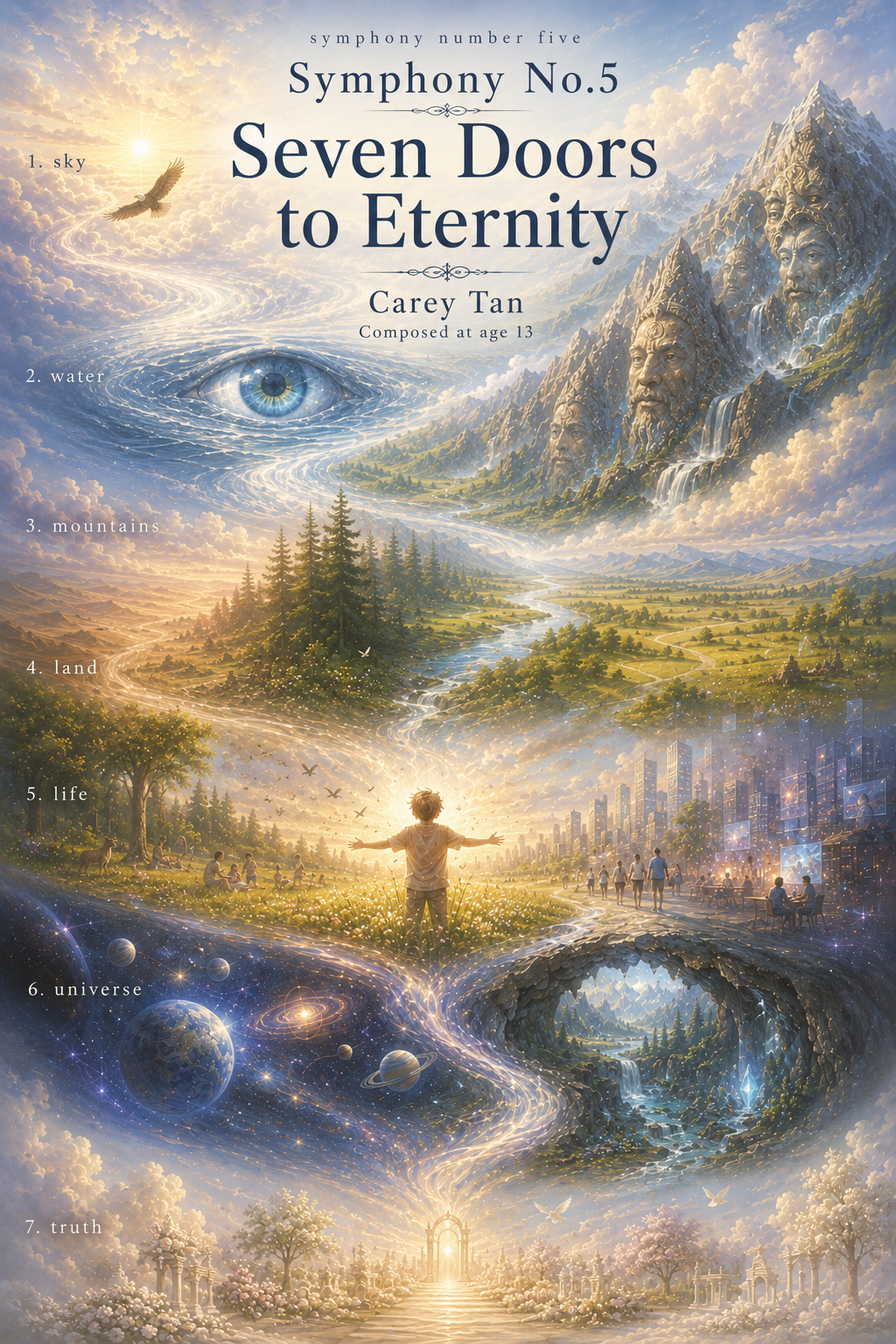
Seven Doors to Eternity follows the journey of a Soul in search of Truth. Passing through seven symbolic worlds — Sky, Water, Mountains, Land, Life, Universe and Truth — the Soul first searches outward, discovering different forms of beauty, mystery and spirit in nature. Its journey then turns inward as it encounters human life, memory and the self. Throughout the symphony, a recurring “Eternity motif” quietly connects these experiences. Gradually, the Soul comes to understand that Truth is not a distant destination to be reached, but a presence that has existed within nature, life and ourselves from the very beginning.
Please close your eyes.
This symphony begins with a simple question: Where do we look for truth?
Do we search for it in the sky, in water, in mountains, in the living earth?
Do we search for it in other people, in the universe, or somewhere beyond ourselves?
Seven Doors to Eternity follows the imagined journey of a Soul as it searches for an answer.
At first, the Soul looks outward. It encounters the sky, water, mountains and land — different faces of the natural world, each offering a different glimpse of something larger than itself. It then enters the human world and discovers a particular life: my own. From there, its journey changes direction. What began as an exploration of the world gradually becomes an exploration of the self.
Throughout the symphony, a recurring group of notes — which I call the Eternity motif — appears in different forms and contexts. Sometimes it is clearly heard; sometimes it is hidden inside the harmony. Like the idea of Eternity itself, it is not always something we consciously notice, but something that quietly remains.
The seven doors are not physical places. They are stages of perception.
Each one brings the Soul closer to Truth.
And as the journey continues, an unexpected possibility begins to emerge:
Perhaps Truth is not a distant destination at all.
Perhaps it has been present from the beginning.
I. SKY
The Soul is born in the sky.
There is no history yet,
no expectation,
no destination.
Only space.
Woodwinds rise into lyrical, ethereal lines.
Strings and winds carry fragments of the Eternity motif within the harmony, as if something ancient already exists inside this newborn world.
The Soul opens its eyes for the first time.
Above it is a blue sky: simple, open and seemingly endless.
Warm horn melodies are surrounded by high woodwinds and low strings. The music does not try to make the sky grand or heroic. Instead, it searches for something quieter: the strange vitality that can exist inside stillness.
The Soul begins its journey with innocence and curiosity.
Soon, it moves among the clouds.
A bassoon rises unusually high, entering a register where its identity becomes less certain — almost like a flute. In this world, appearances are allowed to change. Water vapour may become pillows; a bassoon may become something weightless.
But the Soul cannot remain in the sky forever.
The same musical material returns in another key and passes into trumpet, flute and piccolo. Their different colours suggest widening distances: between nature and artifice, innocence and experience, truth and illusion.
The Soul begins to descend.
For the first time, it leaves a world of apparent purity and enters a world that is imperfect, complicated and full of secrets.
The music ends not with an answer, but with a question.
The Soul must continue.
II. WATER
The next door is water.
We have reached the ground, yet the music is marked elevated. Nature still seems to belong to another level of existence.
Harp arpeggios create ripples.
Flute and oboe become droplets.
The clarinet sings above the slow movement of the double basses.
At first, everything appears calm.
Perhaps even meaningless.
Then, beneath the surface, an eye appears.
This image was inspired by a personal vision I experienced at Heaven Lake in Changbaishan. In the music, the eye first seems threatening. Dramatic melodies and sweeping harmonies disturb the stillness of the water.
The Soul does not know whether to approach it or escape.
But what appears to be an enemy gradually becomes a guide.
The Soul moves towards the eye and discovers tenderness where it expected danger. The harmony passes through darkness and arrives in the warmth of A major.
Mist begins to rise.
Pizzicato strings, marimba and harp fall like small drops of rain, while woodwind lines move gently through the haze. The music continues to climb, becoming lighter and more distant.
The Eye has not given the Soul an answer.
Instead, it has taught the Soul how to look.
And perhaps that is the first step towards Truth.
The waters fade.
Once again, the journey ends with a question.
The Soul must continue.
III. MOUNTAINS
A mountain can be seen as a landscape.
But it can also be seen as a single, unimaginably ancient body of rock.
I have often been fascinated by stones that have existed for millions of years. Each has its own shape, texture, pattern and resonance. Each carries the marks of forces that began long before us.
In this symphony, I imagine these differences as different spirits.
The stones are not lifeless objects.
They carry time.
They carry memory.
They carry energy.
As the Soul encounters them, it becomes aware of something far older than its own existence. The mountain becomes more than a physical object: it becomes a meeting place between the temporary and the enduring.
The Soul rises.
It reaches the summit, and then seems to move beyond it.
From this height it looks back upon everything it has already encountered — the sky, the water, the Eye — and begins to understand that the journey is not made of separate experiences. Each has been part of the same search.
There is sadness in leaving the mountain.
But the Soul cannot remain even among these ancient stones.
Truth is still incomplete.
The journey continues.
IV. LAND
At first, the Soul distrusts the land.
Compared with the mystery of the sky, water and mountains, the world beneath our feet seems almost too ordinary.
Gravity behaves as expected.
Things have names and places.
Everything appears ordered.
Tense repeated strings meet a restricted horn melody. The music seems confined.
But this is only the Soul's first impression.
It is not the truth.
As the Soul begins to explore, the rigid surface opens.
Woodwinds emerge from the texture.
The Soul enters the desert and discovers that an apparently empty landscape is not empty at all. A simple clarinet melody follows the quiet harmony of the dunes, while light touches of marimba, harp and strings reveal a world hidden inside stillness.
Then comes the forest.
Here, life speaks everywhere.
Animals, plants and unseen presences seem to answer one another in a dense network of sound. The clarinet becomes a central voice, drawing the many layers of the forest together.
Beyond the forest lie the grasslands.
The plains seem endless, carried by a soft, flowing harp line and luminous seventh chords. Their beauty is immediate, but their depth cannot be completely possessed or explained.
For the first time, the Soul arrives at a point of genuine relief.
The music settles into D major.
The search is far from finished, but something has changed.
The Soul has learned that profundity does not belong only to the spectacular.
There can be depth in what appears ordinary.
There can be mystery beneath our feet.
V. LIFE
The next door is different.
Until now, the Soul has travelled through nature.
Now it must encounter a human being.
It enters a world we have made for ourselves: a world of order, pressure, expectation and social structure. The opening music is deliberately restricted. A horn melody built from only three notes is held within a restrained orchestral landscape.
The Soul begins searching.
Gradually, the texture opens.
The strings separate.
Woodwind harmonies appear.
And then there is a birth.
A newborn child may cry, but beneath the cry is something quieter: the first experience of simply being alive.
Open fifths in the strings breathe with rising flute and oboe lines, imitating inhalation and exhalation.
The Soul has found the human it was searching for.
That human is me.
The music now enters my childhood.
Two of my earlier works, Crash the Piano and Time to Go Home, appear as memories. They represent two contrasting parts of my younger self.
Crash the Piano carries emotional extremes — excitement, volatility, joy and sadness.
Time to Go Home represents another side: quiet thought, reflection and stillness.
Both belong to the same person.
Both belong to the same life.
And now the Soul and I exist together.
Yet we are not completely united.
Between us stand the pressures, expectations and structures of the world in which we live.
The Soul represents something within me that still remembers how to encounter the world directly.
I represent the person who has lived, learned, changed and entered society.
Together, we continue the search for Truth.
VI. UNIVERSE
The Soul and I now leave the Earth.
But not physically.
This is not a journey into outer space.
It is a journey in the opposite direction.
We appear to leave the Earth only so that we can enter more deeply into it.
What began as a search across landscapes now becomes a descent beneath appearances — into the inner life of the world, and at the same time into our own inner lives.
The music becomes unstable. Extreme instrumental ranges collide with calm, familiar sounds. The grandeur we might normally associate with the universe is replaced by something stranger: the immensity hidden inside the Earth itself.
Low cellos and double basses sustain long lines.
The Eternity motif returns.
Then the high bassoon reappears — a sound we remember from the sky, now familiar and unfamiliar at once.
The orchestra begins to rise.
And finally, for the first time in the symphony, the full orchestra speaks together.
This is the Voice of the Earth.
The Earth is no longer simply a landscape through which the Soul travels.
It speaks.
Its accumulated energy is released, and for a moment the many separate worlds of the symphony become one.
Then the great sound subsides.
What remains is a quiet D-flat major chord in the strings.
The path has been revealed.
The final door can now open.
VII. TRUTH
Truth does not arrive as a sudden piece of information.
It reveals itself gradually.
First, we begin to notice Eternity in the everyday.
Simple woodwind melodies join the Eternity motif. Nothing here needs to be monumental. The extraordinary is no longer somewhere beyond ordinary experience.
Then earlier images begin to return.
The blue sky.
The Eye beneath the water.
The spirits within the rocks.
What once appeared to be separate encounters now seem connected.
They were clues.
Each was a different way of pointing towards the same reality.
The Soul and I look back upon the entire journey: nature, childhood, fear, wonder, separation, memory and discovery.
At the centre of these experiences is innocence — not as naïveté, but as the ability to encounter something openly, before habit and expectation tell us what it is supposed to mean.
A newborn child looks before it judges.
The Soul began its journey in the same way.
And now, after travelling so far, we begin to understand why.
The Voice of the Earth returns, transformed.
Its message is simple:
Truth was never waiting for us at the end of the universe.
It was present in the sky.
It was present in the water.
It was present in the stone.
It was present in the land.
It was present in life.
And it was present within us.
We search the world because we believe that the answer must exist somewhere beyond ourselves.
But the further the Soul travels, the more deeply it is led inward.
To discover the world is also to discover ourselves.
And to discover ourselves is to begin to recognise the Truth that has been quietly accompanying us all along.
The symphony ends in a radiant D major.
It is not simply a chord of triumph.
It is a chord of recognition.
The journey has not conquered Truth.
It has made a friend of it.
An eternal friend.