


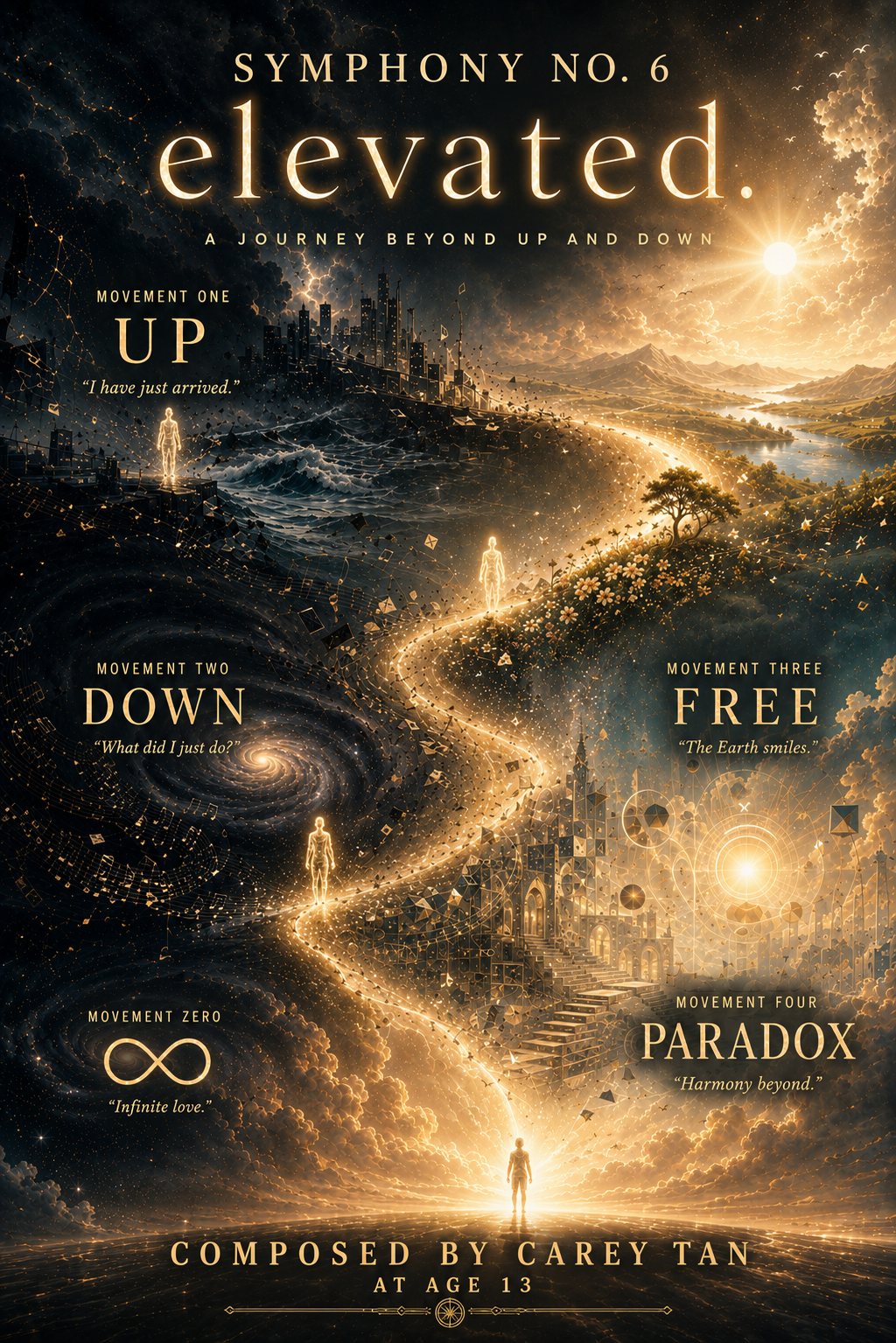
Elevated is a journey of ascent, but not the kind of ascent that we normally imagine.
At first, the protagonist believes that to go up means to gain more: more money, more recognition, more power, more apparent worth in the eyes of society. Yet the higher he climbs in this artificial world, the further he moves away from what actually gives existence meaning. Only when he begins to fall down does another kind of elevation become possible. What appears outwardly to be a descent becomes an inward ascent: towards truth, nature, other souls, God, paradox, and finally infinity itself.
The symphony is therefore not simply a journey from darkness into light. It is about discovering that up and down themselves may not mean what we think they mean. What appears to be success may be emptiness. What appears to be failure may be awakening. Happiness and sadness, grandeur and stillness, the finite and the infinite do not simply oppose one another. Gradually, the protagonist begins to understand that they may need one another.
The work proceeds through four numbered movements—Up, Down, Free, and Paradox—before arriving not at Movement V, but at Movement 0: Infinity. This is not an ending in the conventional sense. It is a return to the beginning, but a beginning understood for the first time.
I. Up
I Have Just Arrived
The symphony begins with birth.
The protagonist has just arrived in a world that he does not yet understand. He is innocent. He has no knowledge of what he will become, what he will desire, what he will lose, or what this world will eventually ask of him.
Soft and calm woodwind melodies create this first atmosphere of innocence, while the strings echo the Eternity theme, a theme that appears frequently throughout many of my works. At this point, eternity is already around him, although he cannot yet recognise it. It exists quietly underneath everything that is about to happen.
The section eventually settles into meditative writing for flute, oboe, and tubular bells. For a moment, there is peace. Nothing has yet been corrupted. Nothing has yet been demanded.
And then greed arrives.
I Will Have It All
Pizzicato strings begin to rise.
At first, the ascent seems controlled, almost mathematical. The structure expands gradually until the entire orchestra has been pulled into the same upward motion. The protagonist has discovered the idea that dominates much of ordinary human society: that to possess more is to become more.
He begins trying to earn money, status, and recognition—not because these things will allow him to serve the world, but because they seem to give him a measurable form of worth.
Everything rises.
Yet beneath the excitement of this ascent is something increasingly empty. He is moving upwards according to the measurements of society, but there is no corresponding ascent of the soul.
Eventually, the music reaches the first great climax of the movement.
And he fails.
This Is Not Over
Failure does not cause reflection. Not yet.
Instead, it produces anger.
This Is Not Over is much more aggressive. The protagonist cannot accept that the world has refused to give him what he believes he deserves. He has tried to acquire wealth and apparent worth, and he has not received enough of either.
His response is therefore not to question the goal, but to pursue it with greater force.
The music becomes increasingly determined and violent. There is a sense that the protagonist is now fighting against the world itself. Yet the tragedy is that he still does not understand what he is fighting for.
This Time I Take Everything
The whole orchestra begins another enormous ascent, but this time the ascent is far less ordered.
The earlier mathematical structures become increasingly disordered. Desire has grown beyond control. The protagonist is no longer simply attempting to succeed. He wants to take everything that he once believed had been denied to him.
And this time, he succeeds.
Look at Me Now
The protagonist has finally acquired what he wanted.
He has money. He has recognition. He possesses the external signs by which society often judges whether a human life has been successful.
He can finally say: Look at me now.
Yet underneath this triumph lies the central emptiness of the movement.
What has he actually done?
What has he done for the world?
What has he done for his family?
What has he done for another human soul?
What has he done for the human race itself?
Very little.
Almost everything he has achieved has been directed towards his own shallow pleasures and towards maintaining an artificial sense of personal importance.
The movement therefore ends at the highest point of his worldly ascent—and perhaps the lowest point of his spiritual life.
II. Down
The title Down is deliberately paradoxical.
Outwardly, the protagonist is beginning to descend. The things by which society measured his success—money, fame, position, and apparent worth—begin to lose their importance.
But spiritually, he is moving in precisely the opposite direction.
For the first time, he begins to rise.
What Is Going On
The movement begins reflectively.
The protagonist has started to recognise something that he was previously unable to see. The life he spent so much time constructing suddenly appears strange to him.
He looks backwards and asks:
What is going on?
How could this have happened?
What did I spend my life doing?
Calm woodwind and string melodies lead him further into this state of reflection. The music is not yet a declaration of guilt. It is something more uncertain: the first moment in which the illusion begins to break apart.
This confusion gradually grows into the emotional centre of the movement.
What Did I Just Do?
Here, confusion becomes sorrow.
The protagonist finally understands the horror of his previous life.
This section is mournful and deeply regretful. It is no longer concerned with society's judgement of him. It is a direct confrontation between his soul and God.
He is saying that he is sorry.
He is sorry for ignoring God, the ultimate presence.
He is sorry for ignoring the needs of God's world.
He is sorry that so much of his life was spent trying to increase his own apparent value while failing to recognise the immeasurable value already present in the lives around him.
For the first time, the protagonist's suffering is not caused by losing something.
It comes from understanding what he himself has lost sight of.
Time for Change
After sorrow comes a quieter thought.
What now?
Time for Change is not a heroic declaration. It is soft and peaceful because real change has only just become imaginable.
The protagonist begins thinking about how a human life might be lived differently. Perhaps life does not have to be a competition for possession. Perhaps it can become an act of connection. Perhaps he can begin to help others—not simply materially, but at the level of the soul.
He begins to imagine what it might mean to truly bring souls together.
The movement ends with a warm brass chord in C major.
It is not intended to pierce the listener with a sense of triumph. It is intended to touch the heart.
Nothing has yet been completed.
But something has changed.
III. Free
The protagonist now makes a decision.
He will free himself from the pressures, expectations, and artificial measurements of ordinary society. He no longer wants his life to be determined by what the world tells him he must possess in order to have value.
Instead, he wants to dedicate himself to something deeper: to nature, to other human beings, to the universe, to God, and ultimately to the possibility of genuine connection between souls.
Unbound
The chains have broken.
Unbound is therefore grand, open, and intensely positive.
For perhaps the first time in his life, the protagonist experiences the world without immediately asking what he can take from it.
Nature opens before him.
The universe opens before him.
God's world, which had always existed around him, suddenly seems immeasurably beautiful.
The music grows into a large orchestral climax in D major, with broad and memorable melodies. Yet this grandeur is fundamentally different from the grandeur of Up. Before, the orchestra rose because the protagonist wanted to enlarge himself.
Now it rises because he has discovered something much greater than himself.
Together
After this great opening comes something softer.
Together is almost an echo of Unbound, but it turns the protagonist's attention away from freedom as an individual experience and towards connection.
He begins to feel that he is not simply united with nature or with the physical universe. He is beginning to sense a connection with every human soul at its deepest point—and through them, with God himself.
This union is not complete. He has not suddenly understood everything, and he has not dissolved into some perfect state.
But he can feel it.
For the first time, the distance between one soul and another does not seem absolute.
The Earth Smiles
The protagonist then begins to notice something much simpler.
The Earth itself seems to smile.
He discovers not only nature's grandeur but also its playfulness, its warmth, its detail, and its depth. The world does not need to announce its meaning through enormous revelations. Meaning can exist in the smallest movement, the smallest sound, the smallest living thing.
Nature becomes intimate.
The Earth is no longer scenery around the protagonist's life. He begins to feel that he belongs within it.
In Another World
The final section turns inward again.
In Another World is dreamlike and meditative. The protagonist begins to breathe more deeply into the essence of what he has discovered.
He is no longer merely observing nature.
He is attempting to feel its soul.
There is a sense of entering another world, although physically he has gone nowhere. What has changed is perception itself.
The movement finally comes to rest on a warm and calm D major woodwind chord.
Freedom has not taken him away from the world.
It has allowed him to enter it.
IV. Paradox
Having rediscovered the world, the protagonist now begins to question it.
His relationship with nature grows deeper, and with it begins his zethersis—his search for truth.
But the further he searches, the less truth resembles a simple answer.
Instead, he begins to encounter paradox.
This movement develops from the law of opposites: the idea that apparently contradictory forces may not simply cancel one another out, but may depend upon one another for their existence.
The movement contains only two sections.
The Unanswerable
Everything initially seems wrong.
A contrabass rises to notes far above its expected register, even above middle C. A cello moves into a register that might normally belong to a violin. Instruments seem to exchange identities. The musical world begins to turn upside down.
The horns sustain extremely long notes across great distances of musical time. Strange layers of texture appear to contradict one another.
And yet somehow, when these contradictions are allowed to coexist, they merge into something unexpectedly beautiful.
The result is ethereal.
The protagonist has entered a world that he cannot solve simply by applying ordinary categories.
Why should high belong to one instrument and low to another?
Why should one thing have to exclude its opposite?
Why should contradiction automatically mean disorder?
The questions become unanswerable.
And perhaps that is the point.
Harmony Beyond
Gradually, the protagonist begins to realise that there may be another kind of harmony—a Harmony Beyond what he had previously been able to imagine.
Memorable, wistful, almost ancient melodies begin to emerge.
At first, this music looks backwards. It feels as if it belongs to something extremely old, perhaps older than the protagonist, older than civilisation, even older than the questions he has been asking.
But these melodies gradually rise.
The protagonist starts to understand the beauty of paradox itself.
The world contains up and down.
Hot and cold.
Light and darkness.
Life and death.
Without one, what would the other mean?
And within the human soul, perhaps the greatest apparent opposites are happiness and sadness.
We often imagine that happiness is something to preserve and sadness something to destroy. Yet both teach us how to understand existence. Sadness allows us to recognise dimensions of the soul that happiness alone cannot reach. Happiness allows us to recognise beauty that sadness alone cannot reveal.
Each makes the other deeper.
Each helps us understand the world more completely.
The apparently contradictory textures of The Unanswerable therefore begin to reveal another kind of order.
The wistful melodies grow into something enormous.
The protagonist no longer experiences paradox as a failure of the universe to make sense. He begins to experience it as part of the universe's grandeur.
The movement ends with large, powerful chords from the full orchestra, arriving finally at a bright and energetic C major.
For a moment, the protagonist sees the unimaginable scale and beauty of God's creation.
But the journey is still not finished.
Or perhaps it has not yet begun.
0. Infinity
You may expect Movement V to follow Movement IV.
It does not.
The final movement is Movement 0.
It is called Infinity.
Zero is not used here to suggest nothingness. It represents a new beginning: a return beyond the ordinary progression of numbers, beyond the idea that existence must simply move from one stage to the next until it reaches an ending.
This movement derives from my idea of the third part of the ZOH, and particularly from herzekia: timeless stillness, or eternity.
After travelling through ambition, collapse, freedom, and paradox, the protagonist now approaches something that cannot simply be treated as the next destination.
Infinity is not Movement V because infinity cannot merely come after something else.
It surrounds the entire journey.
The Voice of Infinity
The origins of this section are very personal.
During a summer holiday in Germany, I found myself facing mountains that were extraordinarily beautiful but also deeply mysterious.
Looking at them, I did not feel that they were silent.
Within each mountain, I seemed to hear a different sound, almost as though different spirits were speaking to me. The landscape did not feel empty or passive. It felt alive with voices that I could not explain but could somehow recognise.
The Voice of Infinity is my attempt to recreate what I heard in that experience.
It is not meant to represent a literal conversation. It is the sensation that behind the visible world there may be something immeasurably larger—that nature can sometimes appear to speak without using language at all.
The protagonist listens.
And the more deeply he listens, the less infinity seems like an abstract mathematical idea.
The Infinite Love
He begins to realise that infinity is not simply endless space.
It is not an endlessly expanding physical distance.
It is love.
More precisely, it is the love that brings hearts together within itself.
The protagonist's search has moved through possessions, suffering, nature, and paradox, but now he reaches something that cannot be measured at all. The infinite is found not by travelling an unlimited physical distance, but through a depth of connection for which there is no final boundary.
One soul can reach towards another.
Humanity can reach towards nature.
Creation can reach towards God.
And through love, these apparently separate things begin to reveal that they were never completely separate.
The Infinite in Grandeur
Infinity then reveals another face.
After rising woodwinds, a loud trumpet melody emerges.
It is one of the most direct and memorable melodic statements of the movement.
Here, the infinite is experienced through grandeur: the overwhelming scale, power, and beauty of existence.
After the inwardness of The Infinite Love, this is almost a sudden opening of the entire universe.
Yet grandeur is not the final answer.
The symphony appears to be travelling towards an enormous orchestral conclusion.
But it turns away.
The Infinite in Grace
The final revelation is quieter.
What seems as though it should become the ultimate orchestral climax instead dissolves into soft woodwind melodies, followed by warm strings.
Infinity is no longer shouting.
It does not need to.
After everything the protagonist has experienced, perhaps the deepest form of elevation is not becoming larger, louder, richer, or more powerful.
Perhaps it is becoming still enough to recognise what has always been there.
This is The Infinite in Grace.
The entire symphony has repeatedly risen upwards, but its real conclusion is found in stillness.
The protagonist began Elevated believing that ascent meant acquisition. He wanted to rise above others, to possess more, and to make the world look at him.
Now he understands elevation differently.
To be elevated is not necessarily to stand higher.
It is to see deeper.
It is to move beyond the artificial boundaries of the self and to recognise nature, humanity, God, happiness, sadness, contradiction, love, and eternity as parts of one immeasurably greater reality.
The symphony does eventually end on a bright and energetic E major chord.
But emotionally and spiritually, that chord is not the true finale.
The true finale has already happened in the quiet music before it: in the soft woodwinds and warm strings, in the protagonist's final moment of reflection, and in the stillness in which he no longer needs to conquer, possess, or even understand the infinite.
He simply experiences it.
And in that moment, Movement 0 becomes both an ending and a beginning.
The protagonist has reached infinity.
And the journey begins again.